

In early October, we followed merchant sites in 28 European countries to their checkout page. We recorded the methods offered and their order, the shape of the journey, the shop’s platform, the processor when it’s available, the countries served, the currencies, and product prices.
Here is what that record shows:
Six methods at the median
The European checkout page has widened. The median is six methods displayed, more than two pages in three show at least five, and close to one in three shows eight or more. The narrow page, with two methods at most, now accounts for only one page in six.
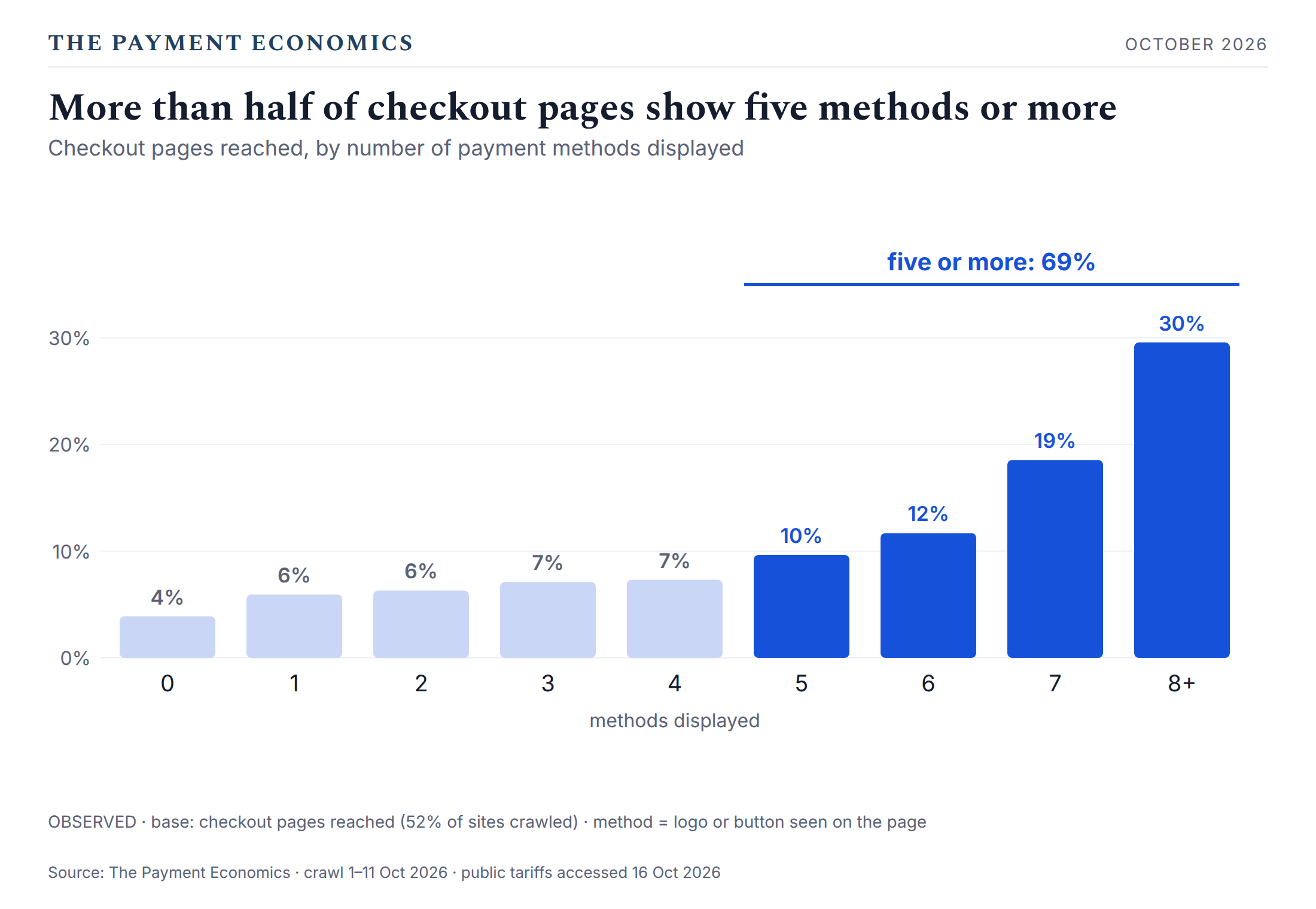
More than half of checkout pages show five methods or more. Checkout pages reached, by number of payment methods displayed. OBSERVED.
On sites where at least one method is visible, wallets — Apple Pay, Google Pay, Shop Pay — appear on 67% of them, PayPal on 57%, instalments on 45% and a local method — iDEAL, Bizum, Bancontact, Blik — on 27%. Since Apple Pay is displayed only in Safari, the wallet share is a floor. The card is still present almost everywhere, but it is no longer alone, nor always first.
Express first, one page
More than one site visited in four (27%) shows an express payment button before the address is even entered. PayPal is clearly the most frequent express button, ahead of Klarna, then Apple Pay, Google Pay, Shop Pay and Amazon Pay. These buttons fill in address and payment in one gesture, and steer the order towards the wallet or provider behind them.
The journey has also become shorter. Among checkout pages whose structure could be read, more than eight in ten fit on a single page. A mandatory account before paying now appears on only about one page in twenty-five: guest checkout has become the norm.
The platform chooses before the contract
The platform the shop runs on decides which methods are displayed by default. On Shopify, the in-house wallet, Shop Pay, appears almost everywhere, and instalments are about twice as frequent as on custom-built sites. Salesforce Commerce Cloud stands out for express payment in the cart, present on more than one site in two. Shopware and PrestaShop show PayPal on a majority of sites, but instalments much less often.
Merchant size follows the same logic: the smallest show six methods at the median, the largest four. Small merchants run on Shopify far more often; much of the width of their page comes from the platform.
Six markets, six profiles
The six best-represented countries in the sample do not pay the same way. The United Kingdom is the wallet market, with wallets on close to four pages in five and almost no local method. Italy is the instalments market, visible on six pages in ten. In the Netherlands, iDEAL structures the checkout page, present on more than two pages in three. Germany stands out for Klarna, Spain for Bizum, on close to one page in three.
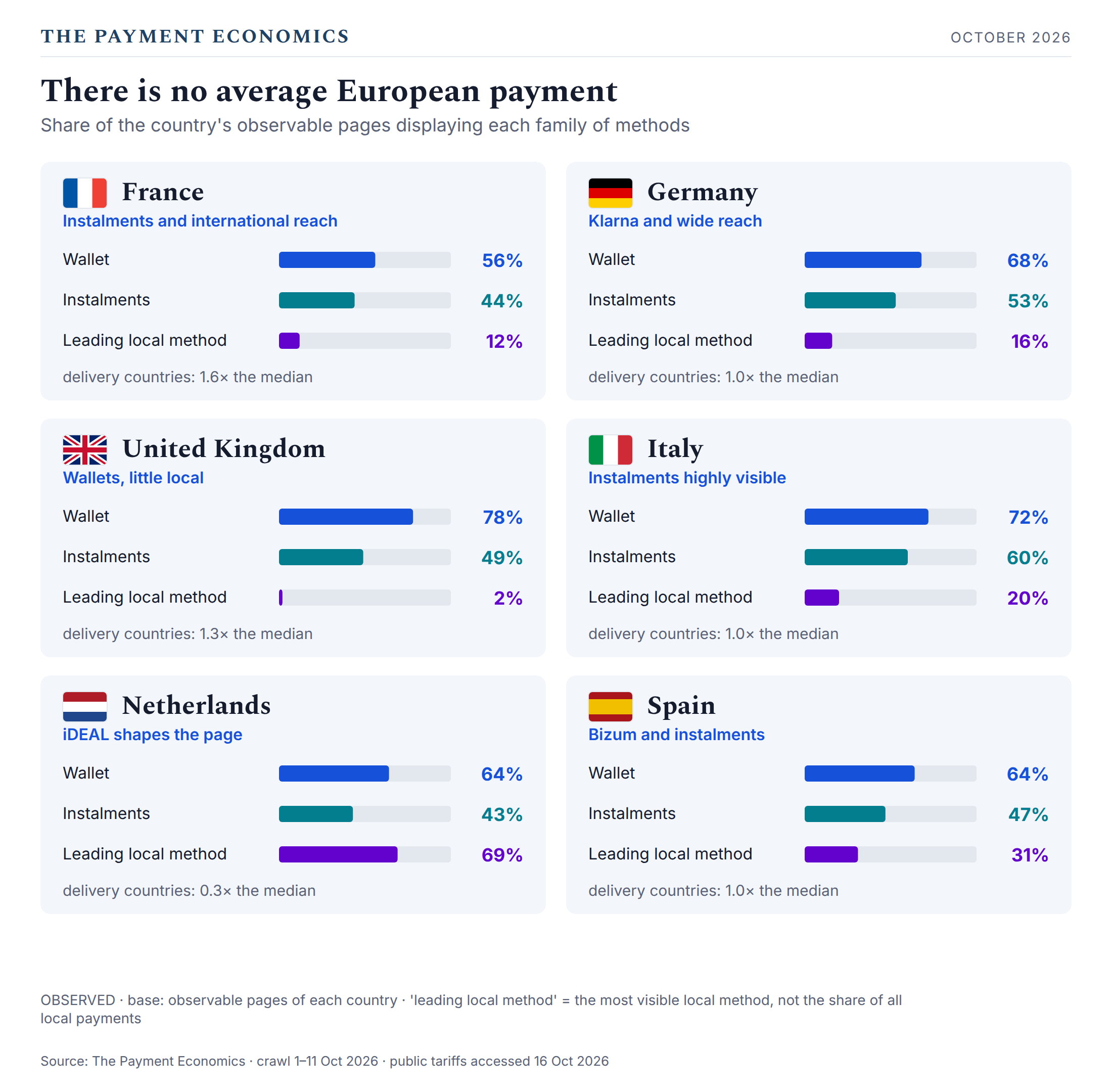
There is no average European payment. Share of each country’s observable pages showing a wallet, instalments and the most visible local method. OBSERVED.
France shows the most internationally oriented profile: its sites offer, at the median, over 50% more delivery countries than the sample overall, while Dutch websites serve roughly one-third as many. On currencies, 7% of checkout pages belong to a site displaying more than three.
Sectors and prices
Fashion is the largest sector in the sample, with about one site in six. Along with sport, it is where wallets and instalments are most visible; food and electronics show them less often.
The price of the first product added to the cart serves as the reference price: €70 at the median across all sites, with the middle half of prices between €28 and €199, and a mean of €236, pulled up by a few expensive items. By sector, the median price runs from €30 in food and €42 in beauty to €89 in home, €94 in fashion, €110 in sport and €189 in electronics.
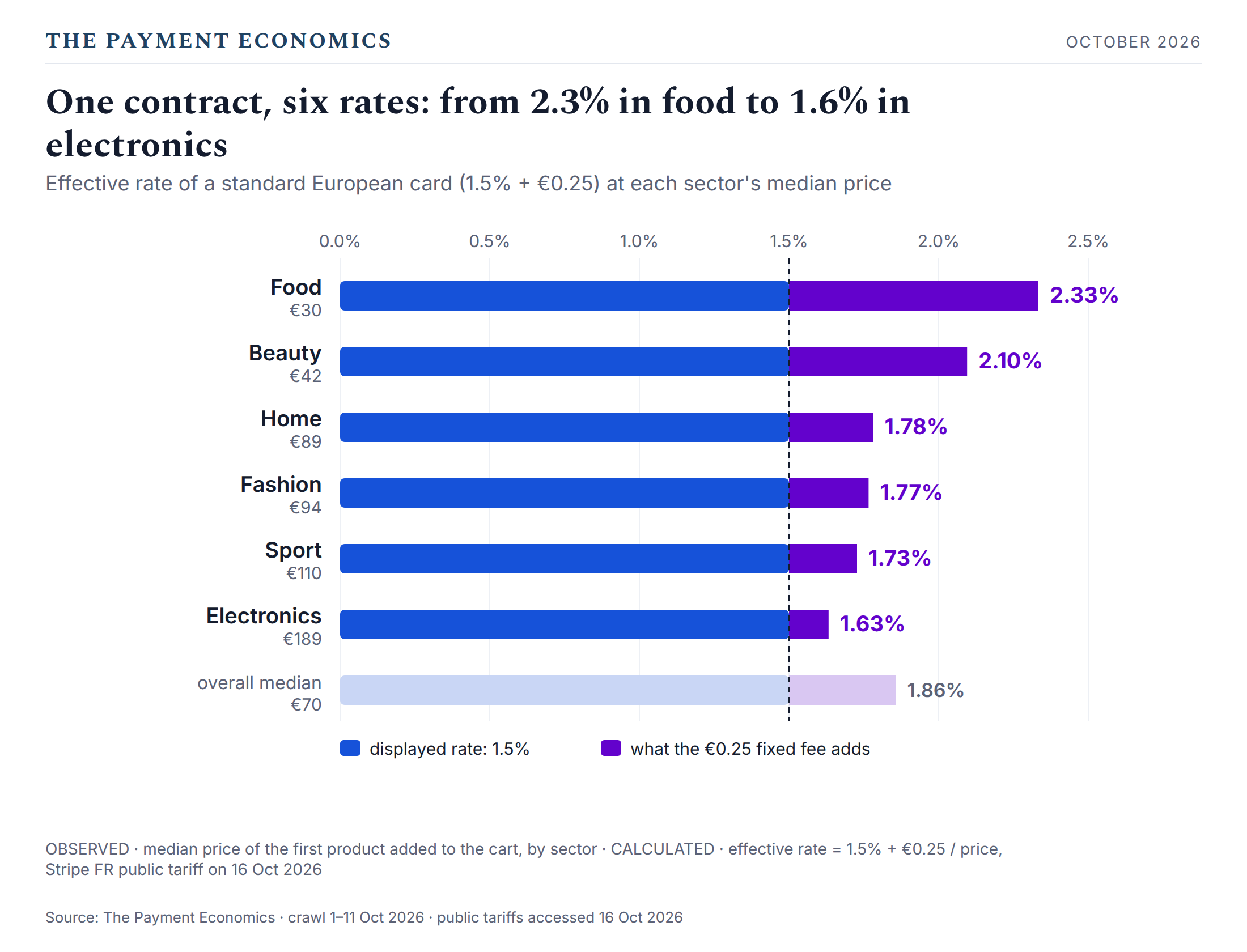
One contract, six rates: from 2.3% in food to 1.6% in electronics. Effective rate of a standard European card (1.5% + €0.25) at each sector’s median price: the displayed 1.5% and what the fixed fee adds. OBSERVED and CALCULATED.
These gaps matter: any tariff combining a percentage and a fixed fee weighs more heavily, in proportion, on low prices. On a standard European card at public pricing, the same contract costs 2.3% of the price to an online grocer whose median item is €30, and 1.6% to an electronics seller at €189: the fixed fee makes up more than a third of the fees for the first, less than a tenth for the second. With the same method, two merchants do not pay the same effective rate.
And what these journeys cost
Applied to the same reference price, public tariffs give very different costs depending on the journey. The standard European consumer card is the reference: 186 basis points, i.e. 1.86% of the price. A premium card costs 1.7 times that reference. PayPal, for a European buyer, 1.8 times. Instalments, at the displayed “from” rate, about three times. A PayPal payment from a non-European buyer with conversion, 4.5 times.
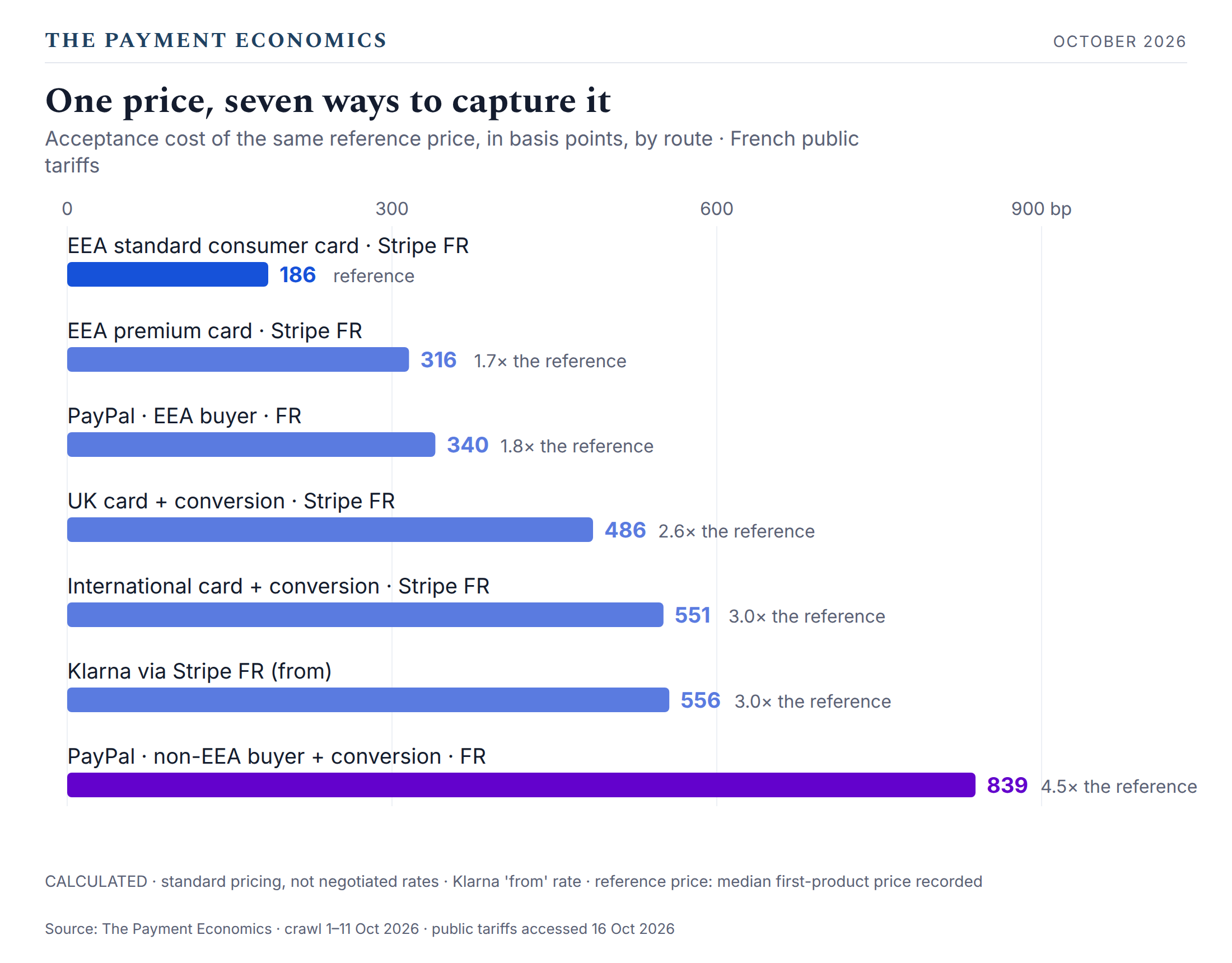
One price, seven ways to capture it. Acceptance cost in basis points, by journey, at French public tariffs re-read on 16 October 2026. CALCULATED.
This is not a ranking of providers; it is an anatomy of cost: negotiated rates move the levels, the mechanics remain. A six-method page, with an express button on top and buyers from several countries, produces a cost composed method by method and market by market.
What comes next
This record is valid for October 2026. Habits evolve, new payment methods appear, the economy shifts baskets, and a Polish checkout page has little in common with a French one. Six countries and six sectors do not describe Europe.
So we will carry on: more countries, more sectors, and the same crawl run again in a few months to see what has actually changed. If a figure looks wrong to you, if you know a source we have not seen or a market we should look at, write to us at the address in the footer.
Contribute to the benchmark
We are building the first European benchmark of effective acceptance cost by vertical, geography and ticket size, for publication in December. Contributions anonymised, methodology published in full alongside the results, dataset shared with contributors before release.
→ Contribute to the benchmark (5 minutes)
Before you go
If this observation is useful, two things help it travel: subscribe to receive the next ones, and forward it to the person who signs your payment contracts. One figure surprised you, or one you would read differently? Say so in the comments: every observation is revised with its readers.
Method: merchant sites crawled from early October 2026. Public tariffs of Stripe France, PayPal France (schedule of 15 July 2026), and Klarna via Stripe.
The Payment Economics · October 2026 · an initiative of the ORYJIN team · contribute@thepaymenteconomics.com
One thing worth checking on method: many storefronts pick the payment methods, currency and even checkout layout they show from the visitor's IP. Where did the crawler run from for each of the 28 countries? If some checkouts saw a foreign or datacenter IP, the 27% "local method" figure and the 7% showing more than 3 currencies could be off for those markets. It's the same family of effect as Apple Pay only showing in Safari, which you already noted.